
 Interview
Midge Ure / The SDE Interview
The ‘man of two worlds’ on his new album

‘Every artist I know lives and breathes on self-doubt’
Midge Ure
Midge Ure, former frontman of Ultravox, is gearing up for the release of his first album of new material in 12 years and an accompanying UK tour.
A Man Of Two Worlds – a double album – is divided into two distinct parts. The first half, World One: Music, is made up of eight instrumental pieces, while the second half, World Two: Songs, consists of eight ‘proper’ songs.
The concept was partly inspired by the time Ure spent during lockdown, listening to instrumental music, and some of the work he heard whilst presenting The Space show on Scala Radio.
Written mostly on keyboards, World One: Music is sparse and cinematic, as well as reflective and melancholy at times – the hauntingly beautiful, ‘Blues and Greys’ is elegiac and autumnal, and ‘The Pictures You Carry With You’ is based on a lullaby-like melody Ure used to sing to his children when they were babies.
The second half of the album, World Two: Songs, shares some of the stripped-down and spacious instrumentation of the first half, but it also manages to find room for the anthemic, stadium-friendly rock/pop of first single, ‘Just Words’, and there are nods to Ure’s Ultravox past with filmic, electronic tracks like ‘World Away’ and ‘Ordinary Man (Precious Moments).’
Speaking to SDE, he tells Sean Hannam about writing and recording the new album, reflects on technology and the state of the world, and gives us some clues as to what we can expect from his forthcoming gigs.
SDE: It’s been 12 years since your last album of new material – why the big gap?
Midge Ure: I’m getting old. At the top of the heap of reasons why it’s taken so long is self-doubt – every artist I know lives and breathes on that. It doesn’t matter what process your latest offerings have to go through to get to the music-listening public, if it doesn’t happen, the first thing you do is not blame them – you blame yourself.
So, there’s an element of self-doubt that runs through everything, and there’s treading in the same footsteps that you’ve taken in the past – you’re working on a piece of music, and you think, ‘that’s quite good,’ and then you wake up in the middle of the night and think, ‘that’s because I did it 30 years ago!’ It’s too similar to something you’ve done in the past.
It doesn’t stop some artists, to be fair…
If you’ve got a wealth of material under your belt, it’s bound to happen – there are only so many notes and subject matter. Then there were other things that happened… Touring takes up a large amount of my time – I’ve done a huge amount of touring over the past decade – and there was lockdown…
There was also boredom. You’re sitting there doing it on your own – there’s no engineer, sidekick or band member. There’s nobody to bounce ideas off and give you immediate feedback on what you’re doing. The only way I can gauge whether anything is worth pursuing or not is to walk away from it and do something else, so my doing something else was to start to write the instrumental stuff.
I’d walk away from a song I was working on, do some work on an instrumental, and then go back to a song maybe a month later. I’m not one of those guys who can just knock up an album and shove it out there – I analyse it way too much.
The instrumental half of the album was partly inspired by the time you spent listening to instrumental music during lockdown, and some of the tracks you heard while curating The Space show on Scala Radio…
Yes – it was a combination of both. For the first time in my life, I found myself in a situation where I’d look in my diary and there was nothing in there. We were all in that scenario and we didn’t know when or if we were getting out, and we didn’t know whether we’d go back to normal life or some radically rearranged one. So, there was a lot of looking out the window. You get up and you twiddle your thumbs or whatever. Fortunately, I had a studio.
Where did you spend lockdown?
In the UK – I was in Bath, sitting there, looking out over the countryside, and seeing it change and evolve. I had a facility to record there, which kept me sane. I could just pop in and start throwing down some ideas – the images that I had in my head. I could tell a story without the help of lyrics or a catchy chorus. It was a bit of a challenge, but I found it quite fun.
I was also curating the late-night music programme The Space on Scala Radio – I don’t think they’d had anyone curate it before. They asked me to do it for a couple of weeks during lockdown, but I ended up doing it for quite a few months. So, I did a deep dive and listened to a lot of the instrumental stuff I’d listened to in the past, and, of course, the algorithms start throwing things at you, and giving you recommendations, so I’d find things like Oliver Arnold and Max Richter, who call themselves ‘neo-classical composers.’ They write beautiful instrumental music.
I’ve always done instrumentals – I think every album has got one or two on there – but I saw what I was doing as two completely different things – an album of songs, which is what I do, and the other stuff as maybe another album at some point. It wasn’t until I’d completed both albums and played them to some friends that they pointed out the records were brother and sister – it was twins. They were created at the same time and belonged together, which excited me because I’d never done that before.
The instrumental pieces are reflective and cinematic – the music is often gentle and spacious, but sometimes elegiac and melancholy…
There’s a lot of melancholy… Think about when a lot of them were created, and, during lockdown, we did reminisce a lot – we harked back to the old days: ‘wouldn’t it be great to go out and meet up with the band again?’ We weren’t allowed to do it for a year and a half, or whatever.
So, there was an element of nostalgia and reminiscence – I was trying to capture what instrumental music did to me as a kid. I’d hear Santo & Johnny, or ‘Wonderful Land’ by The Shadows, coming out of an old valve radio – it was at a time when instrumental musical fitted into the charts. That’s what I cut my teeth on.
Instrumental music made you create your own images in your head – there was no video to go with it. You heard it coming out of the radio and it took you out of the reality you were living in, which, for me, was a tenement slum on the outskirts of Glasgow. Suddenly, an instrumental piece could take you to the South Seas or Australia – anywhere on the planet, or outside of it, depending on how your head worked.
So, that’s what I was with doing with the instrumental stuff, and it’s not just the melodies – a lot of it is about the sound that you use. I wanted it to sound like a band, not like one person playing each individual instrument one at a time. So, it’s slightly loose and it’s kind of ambient in places.
What instruments did you write on?
Keyboards, but I used a guitar synth on a couple of the tracks. I’m not a keyboard player at all, so, everything I do is in the key of C because that’s the easiest way to play a keyboard, so I did a couple of tracks using a guitar synth, playing a piano sound, and that created a different image in my head than if I had played those notes on a piano initially.
The piece ‘Blues and Greys’ has a haunting and autumnal feel – it’s almost classical and it’s very mournful…
It is. It could have gone one of two ways… The guy that I worked with on the songs side of the album, Ty Unwin, worked with me on my album Orchestrated. If I’d worked with him on the instrumental stuff, I think it would’ve been much more strident, grand and pompous.
The instrumental music reflects how it was done – one person in a little room on their own, feeling quite melancholic while writing it. There was no desire to do something big or grandiose, but it has a bigness – I sound like Trump – without being strident. I’m not trying to write classical music. I was trying to write music that I would normally do but using different instrumentation.
There’s a story behind the instrumental piece ‘The Pictures You Carry With You’ – it came from a melody that you used to sing to your children when they were babies…
Yeah – you know what it’s like when you have a babe in arms and they refuse to go to sleep. You’re trying to lull them. I came up with that melody, and every time I picked the baby up, the melody would come back – I didn’t forget it, even though I hadn’t written it down or recorded it – so, every child I’ve had, I’ve sung that melody to them.
While I was in a reflective mood, I thought it would be great to get it down, so I put down a simplistic and repetitive melody and then I wrote a bigger section to go side-by-side with it. I thought it was a lovely thing to do – my kids, when they have kids of their own, will know that tune because they won’t forget it. When I told them I’d done it, they instantly sang the melody to me.
The instrumental half of the album was recorded at your studio, Environment, in Bath, but some of the songs on the other half were done at BooBoo Studio in Oxford…
I did 99 per cent of it at my studio, but Ty has a studio in Oxford – he’s great. I’ve not really had a sidekick since the Ultravox days – someone who will call you up every so often and say, ‘Have you written the lyrics for that song yet?’ or ‘Have you finished the vocals for that track because I’m desperate to try and mix it?’ So, I had Ty to egg me on to get things finished because I was being too pedantic.
I would send him what I’d done and then he’d reassemble all the tracks in his studio, play some of the pieces that I was too sticky at playing, make them better and mix them. So, we ended up doing them with an ocean – or a channel – between us, just using technology to ping them back and forth.
How did you first hook up with Ty?
I met him at Howard Jones’s house – he was having a summer party or something. Ty came up to me and we started chatting – he was an Ultravox, Visage and electronics fan, and he knew more about my stuff than I did; he took it to the nth degree. He’s way beyond anything I can do when it comes to technology and technical creativity.
I was looking for an orchestrator at the time, so I said to him: ‘I presume you’re a proper musician, who can read and write music? Unlike me…’ And he said: ‘If you’re talking about notation and orchestration, that’s exactly what I do.’ So, I got his email, we met up, and he took a classic Ultravox song and did the orchestration for it, and it was outstanding. I knew I had the right guy, and he’s easy to get on with.
Let’s talk about some of the songs on the second half of the album. It kicks off with ‘Just Words,’ which was also the first single. It’s a great song with a big chorus – in a parallel universe it would be a massive hit. It was written about people in power who abuse their positions and don’t tell the truth…
There’s a bit of a theme that runs through the album. You can’t have existed on this planet and not noticed that for the past five or six years, things have been going wrong – the abuse of power and the ability for charlatans to find themselves in those positions. I’ve always written about what affects me or my family – so, the song is just reminding people that words are only words until somebody acts on them – for good or for bad.
‘Just Words’ starts with vocals and a sparse backing and then it builds into a stadium rock anthem-in-waiting, with a couple of guitar solos – it’s a big tune…
Yeah – it builds and it’s got a killer chorus. Although it deals with a fairly dark subject, there’s an element of hope to it. It’s one of the few songs that features a bit of guitar. For a guitarist, I left a lot of guitar off the album – it just didn’t seem to fit with a lot of the stuff.
‘World Away’ is moody and electronic. It sounds like a nod to some of the music you’ve made with Ultravox – that cinematic synth-pop sound…
Yeah – when you’re toying with technology, you find things that make you reminisce. There are elements of it, like the little, samba-type drum machine rhythm at the beginning, and the heavy synth bass, that we used back in the Ultravox days. I think the song is slightly different to what we would’ve done, but there are elements of the sound that is similar.
Earlier, you mentioned the troubled state of the world. ‘Shouting To The Moon’ is a song about unity – how we can change things by working together, rather than being in isolation. There’s a line in it that says: ‘Feast on stupid noise from smart devices – dumbing down to go so low.’ Thanks to smart technology, humans have never been more connected, yet, ironically, it creates isolation too…
It does, but it’s not just that… If you stand at a bus stop or a train station, everyone’s looking at their phones. Those things seem to have taken over – nobody engages personally. The videos people are watching are probably AI, and they see them as absolute truths, which is nonsense.
We can’t depend on any source anymore for what is really happening. Maybe we never could, but right now it seems to be blatant. People can be videoed saying something and it can be shown all around the world, but the next day they’ll deny saying it. And we go, ‘OK…’ None of it makes sense anymore.
So, ‘Shouting To The Moon’ is a bit about that. It also harks back to the Band Aid / Live Aid stuff – one person standing in a field, shouting, won’t be heard, but a million people doing it together will – that’s when things change.
What’s your relationship with technology like?
I still love it. Most of the photographs on the album sleeve were taken on my phone, just because it’s easy and the quality has got better. I like my little boxes that light up and make funny noises, but I’m not consumed by technology. I think a lot of people are. I’m still a sucker for seeing an advert for a new Apple product and thinking, ‘Oh, I need to get that,’ but it’s no different to the one I’ve already got…
There’s this thing now that everything we have is disposable – we have to get rid of the old one because we need a new one… I’m trying to wean myself off that – especially with studio technology, because it takes so long to learn how it works, that by the time you’ve learned to use it, there’s a new version out. You’d never create anything. So, I’m trying to take a break and think, ‘if this was a tape machine instead of a computer, I wouldn’t change it every week…’
How do you listen to music? Are you a vinyl or CD person, or do you stream?
Chrysalis will tell me they’ve got a new cut of the Steven Wilson mix of something and ask me if I want them to send me the vinyl. My deck is in the loft, and I haven’t seen it since 1984! I listen to stuff in the car more than anything – and it doesn’t tend to be music. I tend to listen to talk radio. If I’m listening to music at home, I’ve got a little studio with decent monitors.
Going back to the new album, ‘Caught In The Middle’ and ‘Ordinary Man (Precious Moments)’ don’t address world issues; they are more personal songs. The former tackles human fallibility and the latter deals with mortality. Do you worry about old age?
I don’t. Whatever plan you have in your life – and I’ve never really had one – like, ‘by the time I hit 50 I’m going to do that,’ or ‘when I’m 60, I’m going to do this…’ – none of those things are powerful enough to combat fate. Something comes along that you weren’t planning or that you didn’t expect, it gets plonked right on you, and you have to deal with it. So, I don’t fear anything in the future at all, but there is a reality check… I still have a bright outlook of things happening – the phone ringing or getting an email that says, ‘How do you fancy doing this?’ That’s how it’s always worked.
‘Ordinary Man (Precious Moments)’ feels quite sparse, with synths, a drum machine and what sounds like a synth bass…
It was Ty who came up with that idea. Because the song talks about the past and looking back, he said we should use some of the elements that I’ve used throughout my career. Sadly, Mick Karn isn’t here anymore, so we kind of emulated his bass sound towards the end of the track, and there’s a LinnDrum on it too – something we used during the Ultravox years. In a quirky way, we’ve peppered the track with elements of who I was and what I did in the past, but from different time periods.
Earlier on, you talked about charlatans and you also mentioned Trump – ‘The Man Who Stole Your Soul’ reflects on the current state of the US. I think vocally you sound a bit like Bowie on that track. Is the title a slight nod to ‘The Man Who Sold the World?’
I hadn’t thought of that… I’ve been going to America for a long time. It’s always been the UK’s brother across the seas – and it probably still is – but that’s been hidden by a lot of nonsense. That song points that out – there’s a line in it: ‘The flame from Lady Liberty still casts a light that all the world can see.’ So, it’s not scathing – it’s a love song to America that says, ‘you haven’t lost it yet – we’re still waiting for you to come back.’ For a kid growing up in a tenement slum in Glasgow, America was everything – DC Comics and the movies… That was the big pull.
When did you first go to the States?
I went with Thin Lizzy. I found myself in New Orleans, which didn’t look anything like America – it was like the South of France. America was everything I expected it to be and had hoped it would be. It was rowdy, it was vast, it was violent and exciting, and from the moment you stepped off the plane, it smelt different because of the air conditioning. You knew you were in the States and not in the UK anymore. Bear in mind that I was there with Thin Lizzy, so I was in a limousine and staying in 4-star or 5-star hotels – it was a whole different ball game.
You’re going on a UK tour this month, and then again later in the year. What can we expect to hear? Will you be playing some songs from the new album as well as the older stuff?
Not too much of the new record. I think it’s too much of an uphill struggle for most people to listen to brand-new stuff they haven’t heard before, so I might only do a couple of songs from the new album.
I’ve created a monster because I’ve got the album coming out on the same day as the first date of the tour and they’re both called the same thing: A Man Of Two Worlds. The tour concept was put together before I decided to put the album out – the idea for the tour was to play more of the old instrumentals. I normally throw one in to give me a five-minute breather. I can get my voice back after screaming those hits that everyone wants to hear that I did when I was 25. But I’ve thoroughly enjoyed delving into the instrumentals, so I want to play more of those.
Then I had the problem of how I incorporate those into the show – 50 percent of your audience aren’t there to see you; they’re there to keep their other half happy, and they only know the hits, so you’ll lose them – they’ll be asleep or straight on their phone… So, I thought a way of doing it would be to do segues – start with an instrumental, move into a track they know, do a Visage song, play one of the big hits, then do another instrumental… To take people on a journey and enhance the visuals that will be on stage.
The last part of the show will be the songs that people want to get up and dance to. That’s the concept that’s in my head, but it might change when I get into rehearsals. It’s a difficult thing to pull off technically because there’s only four of us on stage and we’re all changing sounds and instruments, so you have to do that seamlessly.
Do you enjoy touring?
I do – you couldn’t do it if you didn’t enjoy it; it’s too much like hard work. The fun bit is when you’re on stage, and sometimes that’s not much fun if things start going wrong… There’s a lot of hanging about, but that’s all part and parcel of doing it.
What else is coming up? Are there any reissues planned?
We’re working on some of my solo stuff now and we’ll probably look at U-Vox. We’ve kind of exhausted a lot of the Ultravox stuff, but I think what we’ve done with the box sets and the other editions has been fantastic – the remixes and extended versions have been amazing. Weirdly, I’ve done a couple of them. All the original recordings were on tape, so they were transferred to digital and I was sent the files. So, I was playing stuff that was recorded 40 years ago, and I heard things that I’d completely forgotten about. It’s been a fascinating process, rearranging some of the tracks.
With my solo stuff, it’s going to be difficult because for a lot of it I didn’t have a producer, which means I probably have no idea where the master tapes are. It was when technology changed from tape to digital formats and then computer recording. I’ve got no idea about what we’re going to do about getting the original masters.
Finally, which ‘world’ are you in today? Are you in the mood for instrumentals or songs?
I’m probably in an LBC mood. I’ll finish the interviews I’m doing and then go off and listen to James O’Brien moaning for a while.
It’s better than doomscrolling on your phone…
Oh, God – I’ve got to doing stop that, it’s dreadful.
Thanks to Midge Ure, who was talking to Sean Hannam for SDE. A Man Of Two Worlds is released on 8 May via Chrysalis. The tour starts on Friday and you can check tour dates here.
Midge Ure shop highlights
- Exclusive bone coloured 2LP with alt front cover (£34.99)
- 2CD deluxe set (£19.99)
- Bone coloured 2LP and 2CD BUNDLE (£48.99)
Compare prices and pre-order

Ure, Midge
A Man of Two Worlds - 2LP vinyl
Compare prices and pre-order
Ure, Midge
A Man of Two Worlds - 2LP vinyl

|
|
||||||||||||||||||||||||||||||||||||||||||||||||
Compare prices and pre-order

Midge Ure
A Man Of Two Worlds - 2CD deluxe
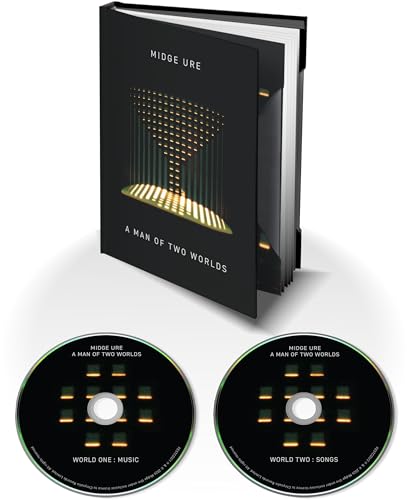
|
|
||||||||||||||||||||||||||||||||||||||||||||||||||||||||||||

Tracklisting

A Man Of Two Worlds Midge Ure /
-
-
CD 1 / LP 1 – World One: Music
- A Different View
- The Space In Between
- Hearing The invisible
- Just Below The Surface
- The Dimming Light
- The Other Side
- Blues and Greys
- The Pictures You Carry With You
-
CD 2 / LP 2 – World Two: Songs
- Just Words
- World Away
- Shouting To The Moon
- Caught In The Middle
- Ordinary Man (Precious Moments)
- Somewhere Out There
- The Man Who Stole Your Soul
- Fan The Flame
-
CD 1 / LP 1 – World One: Music
 News
News


By Sean Hannam
24